Ancient Celtic Symbols: History, Meaning & Spirituality
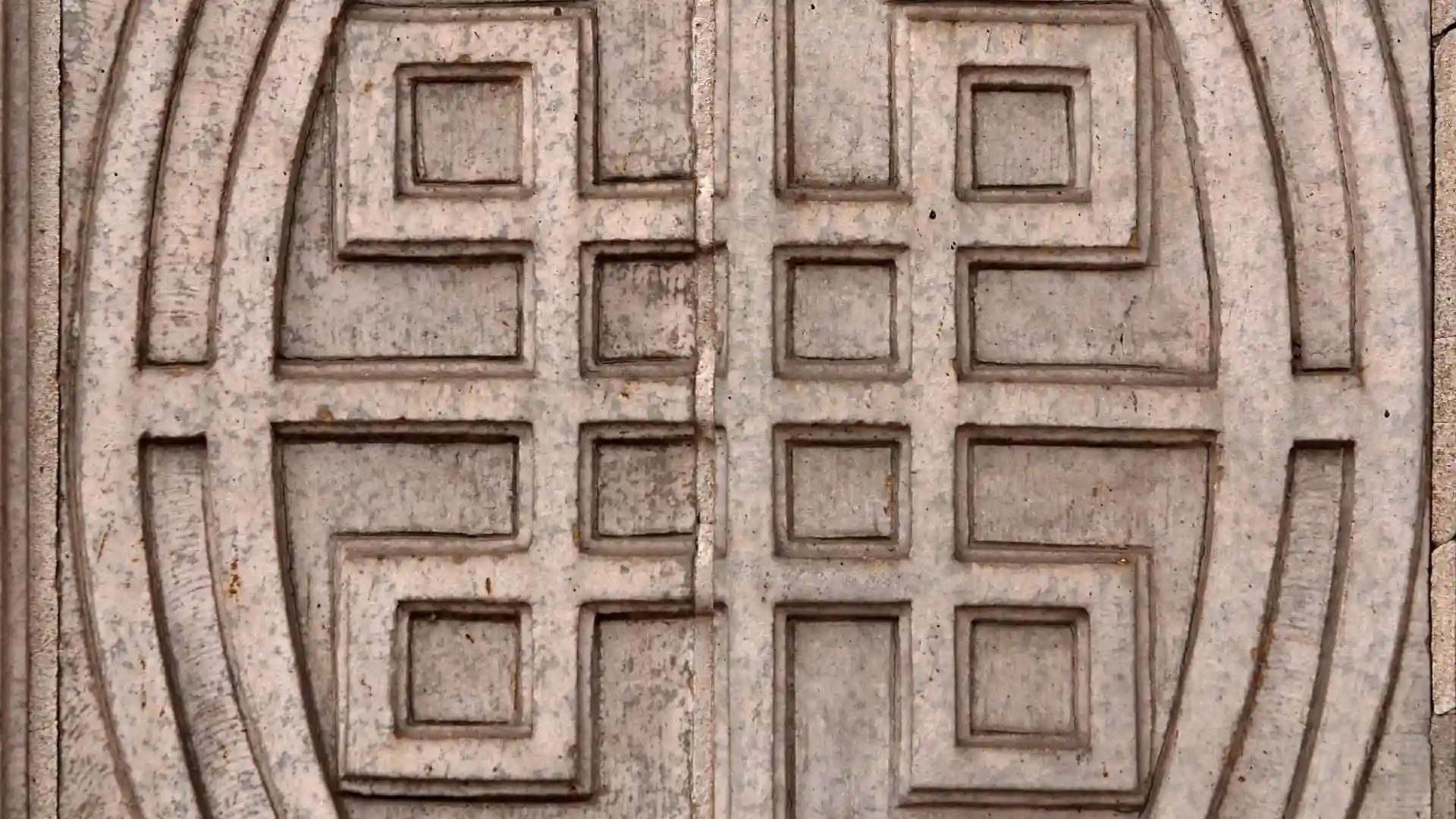
Celtic symbols Ireland can be traced to the ancient historical and archaeological periods. These were used by the Celts long before the coming of Christianity. The Celtics used to pass down the knowledge by the method of symbols and oral traditions. Hence, these designs weren’t just symbols.
These were signs of identity, nature, and spirituality that depicted meaningful stories, values, and beliefs of people. Irish Celtic symbols consist of knots, animals, spirals, and the Ogham alphabet. Specific tales and history are associated with each Celtic symbol.
Some symbols, such as the knots, are associated with strength; others, like the spirals, symbolize connections that encompass people and nature. In this guide, we have discussed the history and meaning of each ancient Celtic designs. These symbols are a great way to learn about the lost Celtic heritage, Irish jewellery, or Celtic tattoos.
Nature & Life Celtic Symbols.
Every animal, river, and tree evokes nature’s wonders. Hence, Celts consider them divine. They have a deep connection with these symbols as life, growth, and nature of existence are evident in them.
Tree of Life (Crann Bethadh)
The Tree of Life is also referred to as Crann Bethadh in Irish. It is a powerful Celtic symbol of Ireland that showcases the spiraled union between branches and roots. This symbolizes the connection between the heavens, the Earth, and the underworld. In ancient times, Celtic people viewed the tree as a symbol of balance and harmony.

The representation of different spiritual worlds serves as a powerful emblem of renewal. Bearing witness to the life and death cycle through autumn leaf shedding only to be renewed in the spring, the Celtic people admired trees as a symbol of rebirth. They also believed that trees provided wisdom and longevity as they embodied the spirit of their ancestors.
Single Spiral
The single spiral is probably the oldest Irish symbol known, with examples located at Neolithic sites such as Newgrange. These are over 5,000 years old, dating back even before the arrival of the Celts. The single spiral symbol embodies life energy, expansion, and growth. The single spiral is continuous and flowing, which means an unbroken journey.

It is often interpreted as the path of life, consciousness, or the universe. The single spiral is often perceived to depict the voyage of life. The focus of the spiral, clockwise or anti-clockwise, was thought to have some meaning. Clockwise spirals were believed to represent harmony in conjunction with the natural order of the Earth.
Triple Spiral (Triskele)
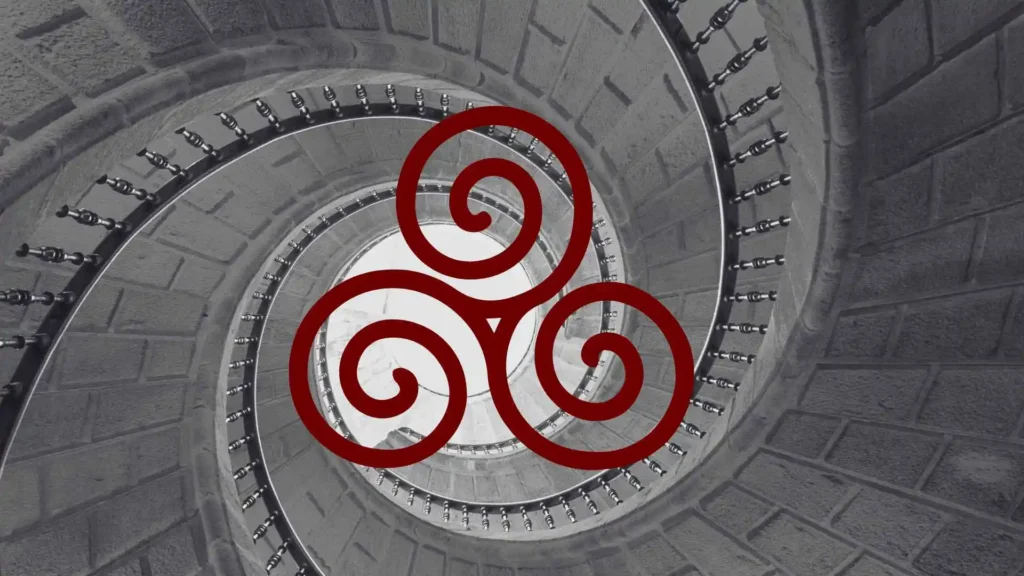
The triple spiral is sometimes referred to as Triskele or Triskelion. It is characterized as a dynamic ancient Celtic symbol that underpins the meaning of the number three. The three interconnected spirals depict life, death, and rebirth, which can also signify the three different realms of Earth, sea, and sky. Additionally, it can also represent the past, present, and future.

The symbol appears to have perpetual motion as it also depicts progress, movement, and the will to overcome struggles. The triple spiral is a powerful emblem of ancient Celtic designs that perfectly represent the continuous flow and the cyclical nature of existence.
Solar Wheel
The Solar Wheel can be illustrated as a cross within a circle. An emblem of ancient Celtic heritage associated with sun worship and the cycle of the heavens. The symbol captures the sun’s movement, as well as the seasons and the farming calendar, which was essential to Celtic civilization.

This symbol represents the Celts’ spirituality and devotion to the life-sustaining sun and the rhythms of nature. It also describes the concepts of wholeness, totality, and time as a cyclical process.
Green Man
The Green Man is a significant motif in ancient cultures that the Celts also employed. It symbolizes nature and renewal. This nature god, represented with a human face sprouting from or made of leaves, marks fertility and the rebirth.

It is associated with the cyclic return of spring and summer. The Green Man illustrates the profound connection between humans and the forces of nature. It reminds people of the Earth’s renewal capabilities and the cycle of life itself.
Celtic Knot Symbols
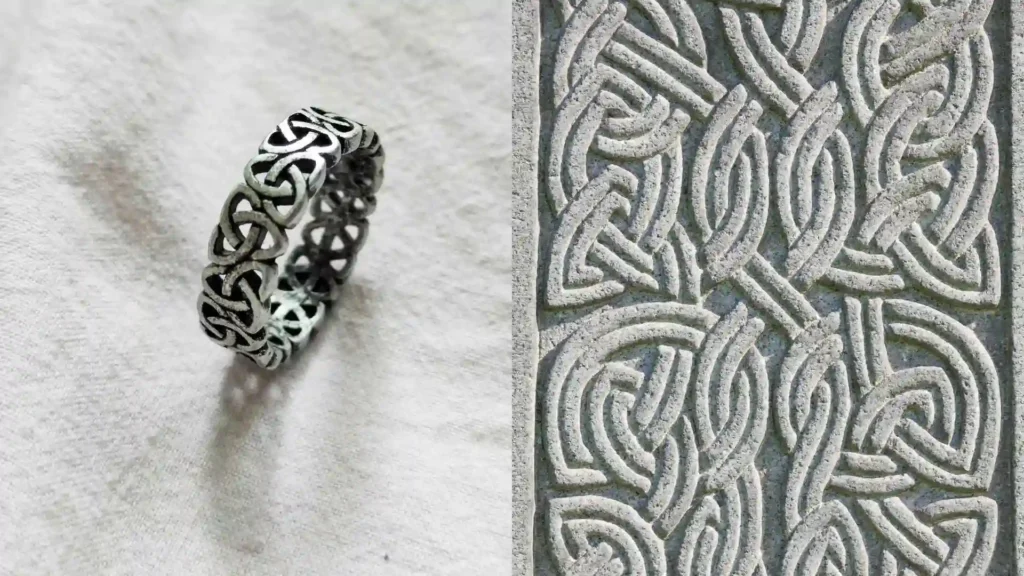
Arguably, the most captivating and recognizable feature of Celtic art is the Celtic knot. These celtic symbols for families are complex, interwoven designs with no specific beginning or end. Celtic Knot meaning revolves around eternity, the cycle of life, and the interrelatedness of existence.

Triquetra (Trinity Knot)
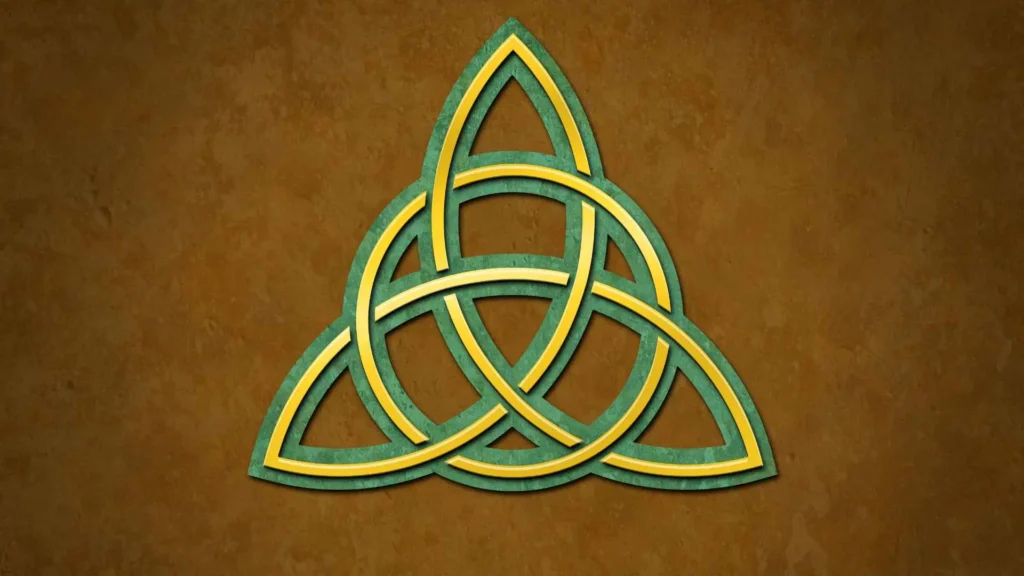
The Triquetra or Trinity Knot is perhaps the most famous Celtic knot. It consists of three interlocking loops which form a triangle. It is significant for both pagans and Christians. It may have represented the triple goddesses, the three realms which include land, sea, sky, or the cyclic nature of life, death, and rebirth in pre-Christian times.
Christians later adopted it as a symbol of the Holy Trinity, comprising the Father, the Son, and the Holy Spirit. The symbol is often associated with families and is used in marriage rings, jewelry, and tattoos, signifying boundless affection.
Dara Knot
The Dara Knot is a potent Celtic symbol embodying strength and inner wisdom. The name Dara is associated with the Irish word “Doire,” meaning “oak tree.” The design of the knot is said to represent the sophisticated root structure of an ancient oak.
Like the oak tree, which stands firm against the gales and grows strong over centuries, the Dara Knot represents resilience, enduring power, and inner fortitude. Due to these associations, the Dara Knot is often regarded as a Celtic symbol of strength or a reminder of one’s foundational wisdom.
Shield Knot
Shield Knot is another ancient symbol of protection. It is characterized by four distinct corners, which are commonly square or rectangular. The knot can protect and ward off evil spirits. It is believed that it protects the person who possesses it. In ancient times, it was worn by warriors as part of their armour.
The name Shield Knot comes from the fact that the knot is designed with intricate closed patterns, which reinforce the protective qualities of the symbol. This makes this particular knot a potent guardian symbol among Irish Celtic symbols.
Eternity Knot
The Eternity Knot has continuous, unbroken lines that signify timeless bonds or everlasting journeys. As its name suggests, the Eternity Knot conveys the ideas of the life and death cycle, infinite connection, and eternal devotion. Its unbroken lines, much like other Celtic knots, portray enduring bonds or journeys.
This design makes it a sought-after symbol of life, love, and relationships. Hence, it’s a popular motif used to symbolize cherished bonds and the belief in eternal continuity.
Serch Bythol (Love Knot)
The Serch Bythol is known as the love knot, which translates to “eternal love.’ It is a relatively uncommon but significant piece of Welsh etymology. The fancy intertwining of two Triquetras also forms this knot.
This knot is primarily used to symbolize eternal devotion and love between two individuals. Thus, it represents two bodies joined forever in mind, body, and soul. This piece of Celtic love knot is a fantastic symbol for any unbreakable, timeless, romantic relationship or profound partnership.
Joseph Knot
The Joseph Knot is quite rare. This Celtic knot is associated with storytelling and complex narratives. While it doesn’t have as much fame as the Triquetra or Dara Knot, it does have an image of complex intertwining strands, which evokes the idea of fates, journeys, or tales that unfold complex narratives.
The meaning of the Joseph Knot is often based on personal interpretation. It can vary according to specific family histories as well. Hence, it resonates differently for many and serves as a beautiful symbol of intricate value.
Sailor’s Knot
The Sailor’s Knot, often referred to as a symbol of bound love, is used by sailors to showcase their enduring connection to their loved ones back home.
Formed with two ropes tied together tightly, it symbolizes fidelity, affection, and a safe return home to reunite with loved ones. This knot is a bold symbol of enduring bonds that bear the long distance and wait patiently with loyalty.
Spiritual & Religious Celtic Symbols
The spirituality of the Celts is rich and complex. It integrated earlier pagan traditions and was subsequently impacted by Christianity. Hence, many symbols represent profound ideas of faith, wisdom, and the divine.

Celtic Cross
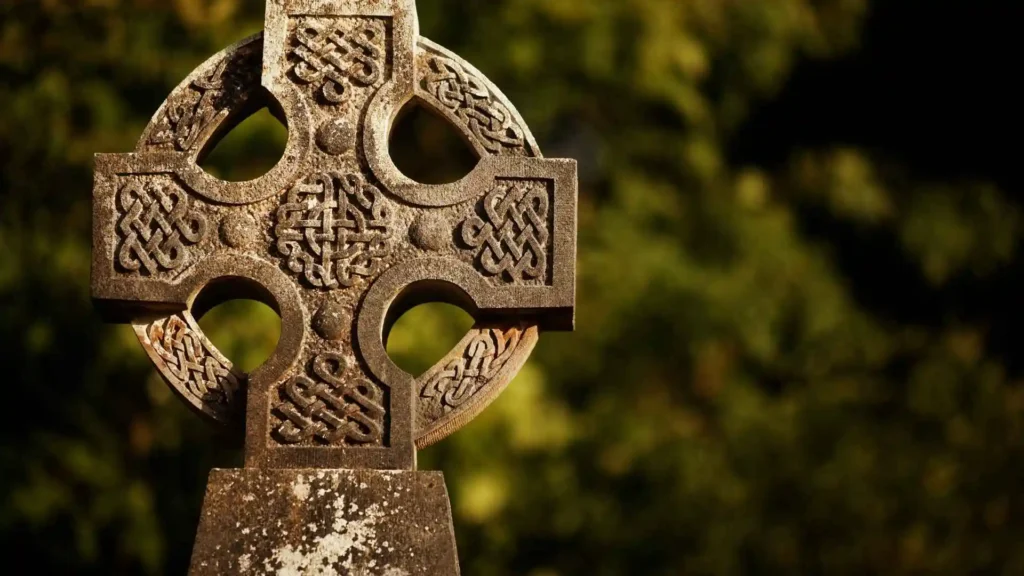
The most recognisable of all Irish Celtic symbols is the Celtic cross. This symbol is a powerful amalgamation of Christianity and paganism. It is a cross, traditionally used in Christianity, with a halo encircling the intersection of the arms.
While widely adopted by Christianity to symbolize Christ’s crucifixion, its circular component is believed to come from earlier pagan sun wheels. Thus, the Celtic cross meaning is connected to the life-giving power of the sun. The four arms can also represent the four cardinal directions, the four elements (Earth, air, fire, and water), and the four seasons.
There are ancient stone Celtic Crosses from the Early Middle Ages that can be found all over Ireland. They are a testament to enduring faith and heritage.
Ailm Ogham
Ailm is one of the spiritual Celtic symbols from the Ogham writing system of ancient Ireland, where letters corresponded to trees. Ailm represents the letter ‘A’. It is often associated with the silver fir or pine, and embodies strength, endurance, and clarity.
In the Celtic tree lore, evergreen trees like the fir were associated with healing and purification of the spirit. Thus, the Ailm represents not only physical resilience but also mental and spiritual fortitude. It often means the ability to foresee the future. As a spiritual Celtic symbol, the Ailm is a profound depiction of inner strength.
Fivefold Symbol / Wheel of Being
The Wheel of Being, or Fivefold Symbol, is made of a single central ring accompanied by four others. This Celtic symbol is spiritual and profound. Each ring holds powerful spiritual significance connected to the five elements of fire, air, Earth, water, and spirit.
The central ring typically represents spirit, while the four others embody the tangible elements. This symbol embodies wholeness, balance, and the interrelationship of all things related to existence. The symbol serves as a guide for seekers on the path to enlightenment and the wisdom of the universe.
Celtic Mandala
While not a fully-fledged Celtic symbol like knots or spirals, a Celtic Mandala refers to circular motifs in Celtic art. It expresses a sense of spiritual wholeness, balance, and meditation.
Like in other cultures, these intricate and often symmetrical circles are used as meditation aids, tools for self-examination, and facilitators of inner peace. Life and the universe, as the Celts perceived, consist of interlocked, flowing elements and a cyclic nature. Thus, the concept is mirrored in these designs.
Triquetra (as Holy Trinity)
The Triquetra, also known as the Trinity Knot, is an ancient Celtic symbol that gained new significance with the later adoption of Christianity, representing the Holy Trinity: God the Father, God the Son (Jesus Christ), and God the Holy Spirit. Its form, which is unbroken and interwoven, is an ideal representation of the ancient three divine entities.
These, in essence, are one and indivisibly intertwined. The Celtic artistic heritage in that context served as a bridge, allowing the adoption of the Triquetra as a symbol in Christian Ireland. Here, it became one of the strongest and most cherished symbols of faith.
Warrior & Protection Celtic Symbols
The ancient Celts were famous for their warriors. Hence, warrior Celtic symbols became popular to represent courage, protection, and strength. Animals and objects were used to symbolize the fierce and protective qualities.

Boar
In Celtic societies, the boar exemplified courage and tenacity. It was viewed as a sacred animal. With the image of a boar, Celtic warriors used to decorate their helmets and shields. It signified their readiness and relentless nature towards battle. Along with this, the boar was also connected to Celtic God Moccus, who was a deity of swine.
It was associated with fertility and life. This connected the boar to sacred power. Warriors had the Celtic symbol strength of the fearsome and relentless boar, marked on the seals.
Sword & Spear
The Sword & Spear are another vivid example of Celtic symbols associated with warriors. The weapons, a spear and a sword, symbolized power, sacrifice, and, most importantly, battle readiness. With the sword symbolizing authority, it was associated with justice, truth, and the ability to cut through illusions.
The spear, with its piercing nature, signified martial skill, sacrifice, and precision. These forms of weapons were not simply tools but extensions of the warrior’s commitment and spirit.
Horse (Epona)
The Celts considered the horse valuable, as it represented great strength, speed, nobility, and life itself. Epona, the Celtic goddess of horses, mules, and donkeys, was worshipped across Gaul and Britain. It indicated the animals’ significance in daily life, transportation, and warfare.
Spiritually, horses were believed to aid in the guidance of souls, marking the journey from life to death and back to life transformation. The horse, as a Celtic symbol of strength, represented bestial power and boundless freedom.
Stag
The Stag, with its impressive and noble antlers, was a symbol of the masculine, nobility, and leadership in Celtic culture. Stags also shed and regrow antlers. The renewing process made it a symbol of ceaseless life, rebirth, and the natural renewal cycles.
As a creature of the wild, the StagStag also represented the epitome of savage self-reliance, a deep connection to the forests. This Celtic symbol embodies strength and dominion of nature.
Celtic Dragon
In contrast to some cultures where dragons are considered solely evil beings, the Celtic Dragon was revered as an embodiment of both chaos and creation. Sometimes depicted as a mighty serpentine beast, the Celtic Dragon was considered a powerful guardian of knowledge, wisdom, and treasures. It was associated with the Earth’s energies and ley lines.
Celtic dragons represented aspects of tremendous strength, ancient magic, the cyclical and recursive nature of existence, and the primal forces of everything that shape the world. It is considered a powerful Celtic protection symbol, said to guard sacred sites and conceal knowledge.
Mythical & Animal Celtic Symbols
Celtic mythology has wonderful animals and creatures that serve either as guides, protectors, or bestow great wisdom. Each one of them carries tremendous meaning.

Salmon of Knowledge
The Salmon of Knowledge is irreplaceable in Irish mythology. It bestows wisdom, inspiration, as well as insight. In Fionn Mac Cumhaill’s tale, he was granted all the knowledge of the world after consuming this magical fish.
Determined and persevering, the Salmon’s ability to swim against the strongest currents also symbolizes the pursuit of truth. This analogy is an excellent representation of the pursuit of intellectual curiosity as well as the great journeys one must undertake to acquire understanding.
Hounds of Culann
The Hounds of Culann are Irish mythological creatures renowned for their fierce loyalty and protective nature. In the epic Ulster Cycle, a young hero, Sétanta, earned the name Cú Chulainn (Hound of Culann) after he bravely killed a vicious hound and promised to take its place.
These hounds are loved for being excellent symbols of loyalty, guardianship, and protection. They symbolize the epitome of vigilance and the relentless protection of one’s home, loved ones, or cherished values.
Raven / Crow
In Celtic folklore, ravens and crows are intelligent and enigmatic creatures. They served as the connection between humans and the Otherworld, possessing richly layered meanings. They are regarded as the Goddess Morrigan’s crows, who are known to metamorphose into a crow.
With such transformation, they signify foresight, warfare, demise, and metamorphosis. They are powerful conduits of ancient knowledge and the mysteries of the unseen realms, embodying both wisdom and foreboding.
Serpent
Folklore depicts the serpent as a shrewd creature capable of shedding its skin. It is a global emblem of shedding the old to reveal new beginnings, renewal, and metamorphosis. Within the Celtic context, the serpent’s shedding skin was associated with far deeper meanings, such as healing, fertility, and the wisdom of the Earth.
Also, the serpent’s endless coil is a symbol of eternity and life after death. Its presence in ancient Celtic art underscores a belief in constant change and regeneration.
Wolf
The Celtic myth of the wolf paints it as a fierce guardian of the wild and untamed elements of nature. The wolf as a symbol represents great loyalty and family bonding, as wolves typically live in packs.
Wolves are sometimes viewed as wild and fierce, but they are also appreciated for their intelligence and remarkable abilities. They are known to be cunning and have a connection with the spirit world. The wolf symbolizes fierce independence and the primal wisdom of the natural world.
Cultural & Identity Celtic Symbols
Aside from spiritual and natural depictions, some Celtic symbols serve as emblems of national pride, cultural identity, and distinctive modes of communication. They are also associated with some Irish phrases as gaeilge.Â
Ogham Alphabet
The Ogham Alphabet is a remarkable and distinct Irish system of writing, comprising 20 letters. Each is represented by various notches or lines cut on a central stem line. It was mainly used on monumental stone pillars from the 4th to the 7th centuries AD. It functioned as an early form of writing among the Celts in Ireland and parts of Britain.
Each letter of the Ogham alphabet was symbolically associated with a particular tree or plant, infusing the alphabet with spiritual significance. Furthermore, it connected the writing system to nature and ancient Celtic lore.
Celtic Harp
The Celtic Harp is one of the most cherished and long-lasting icons of Irish Celtic culture. Its deeply moving melodies were vital to Celtic life, capturing emotions of love and devotion, defiance and struggle, and deep national pride.

Harps were vital to Celtic and Gaelic societies as they signified royalty and the immortality of the soul. Later on, they became a symbol of Irish identity and spirit. Its cultural significance was so deeply rooted that the British tried to suppress it during the 16th century. Today, it is a source of immense pride as it showcases Ireland’s extensive history and culture.
Shamrock
The Shamrock is a powerful emblem of identity for the Irish people. It is often mistakenly thought of as an ancient Celtic symbol. It is a small three-leafed plant. Some believe that Saint Patrick used it in the fifth century to teach the pagan Celts the philosophy of the Holy Trinity (which is the Father, the Son, and the Holy Spirit).

Although the Druids revered the number three, the strong connection that the Shamrock has with St. Patrick ensured that it became a symbol of Irish faith and heritage. It symbolizes ideals of faith, love, and hope. It is now a symbol of Ireland that is recognized globally.
Modern Usage of Celtic Symbols
Just like Irish expressions, Celtic designs today are also gaining popularity more than ever. The symbols are being utilized in various contemporary art forms to preserve their beauty and meaning.
Tattoos
A common practice is to use them in tattoos. The most popular Celtic symbol tattoos include Triskele, Dara Knot, and Triquetra. They portray love, balance, and spiritual growth. It is not just the art that makes it so famous. It is the deep personal meaning these symbols hold.

Jewellery
The spirals, twists, and Celtic crosses are in very high demand as Irish jewelry symbols. They are crafted in earrings, wedding rings, and pendants to propagate Irish culture. Many people worldwide adore them due to their elegance and timeless designs.
Branding & Tourism
Guinness and many other products incorporate Celtic symbols in their products. They are a common sight in branding and tourism in Ireland. As they are part of Ireland’s rich culture and history, they help spread it all over the world.
Today, there’s also a growing interest in Celtic spirituality. Many people use these symbols in modern rituals, meditation, and nature-based practices. The ancient meanings continue to resonate with ideas of harmony, nature, and inner strength.