
Best Time to Visit Ireland by Month

Ask ten people from Cork to Cavan when to go and you get ten answers, and every one of them involves the weather. Ireland changes its mind about the sky several times a day, so picking the best time to visit Ireland feels like a gamble.
You want long evenings, mild temperatures and a bed that does not cost a fortune, and you do not want to queue for an hour at the Cliffs of Moher in the drizzle.
This guide uses Met Éireann climate averages, Central Statistics Office visitor figures and daylight data to cut through the guesswork. You get a clear answer first, then a month by month breakdown, plus advice for specific plans like Skellig Michael, Dublin and the Wild Atlantic Way. By the end, you know exactly which month suits you.
Quick Facts
Question | Answer |
| Best all round months | May, June and September |
| Warmest months | July and August |
| Sunniest month | May, per Met Éireann 1991 to 2020 averages |
| Longest days | About 17 hours of daylight in Dublin around 21 June |
| Peak month for overseas visitors | August, with 772,800 in 2025 (CSO) |
| Quietest months | January and February |
| Average yearly rainfall | 1,288 mm (Met Éireann, 1991 to 2020) |
| Skellig Michael landings | May to September, weather permitting (OPW) |
The Short Answer
The best time to visit Ireland is May, June or September for most travellers. These months give you the best odds of dry weather, long daylight and open attractions, without peak summer pressure. May is the sunniest month on average, according to Met Éireann, and June gives you the longest evenings.
September keeps much of the warmth once the school holidays end. Choose July or August if you want the warmest weather and a busy festival calendar, and book early.
Choose winter if you want cheaper rooms and quiet roads, and accept short days and wilder weather.
How to Choose Your Month
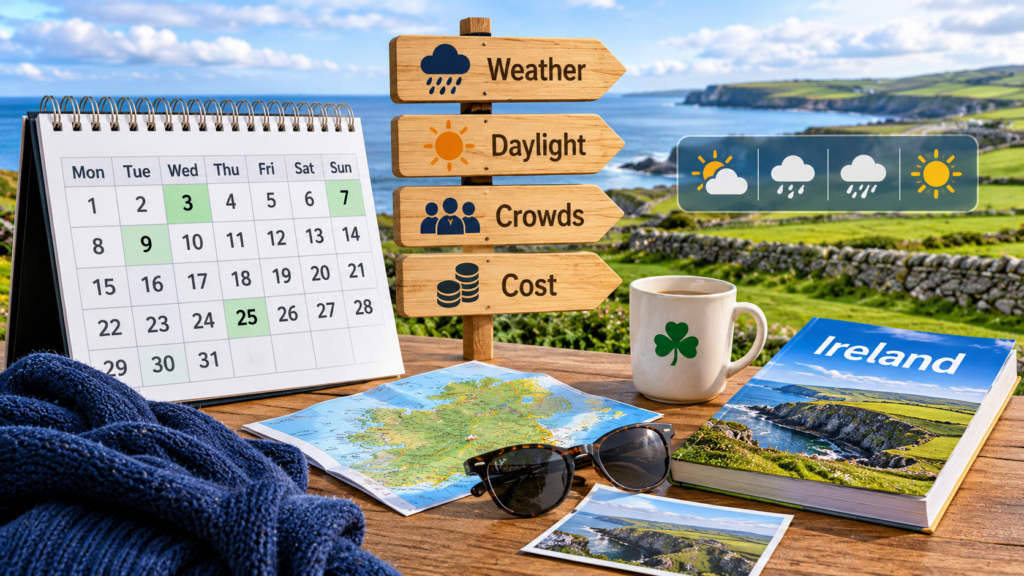
Four factors shape your choice: weather, daylight, crowds and cost. Rank them by what matters most on your trip, then match your priorities to a month below.
Weather and Rainfall
Ireland has a mild, humid and changeable climate with plenty of rain and no extreme temperatures. Met Éireann figures for 1991 to 2020 put annual rainfall at 1,288 mm and the yearly average temperature at 9.8°C. Rain falls in every month, so no season guarantees dry days.
Locals call a drizzly morning a soft day, and you meet plenty. The west coast takes the full force of Atlantic wind and showers, while the southeast tends to run drier and sunnier. July and August bring the highest temperatures, yet May often delivers the sunniest spells. Check the forecast on met.ie each morning and keep one flexible day in your plan.
Hours of Daylight
Daylight shapes your day more than most visitors expect. Dublin gets about 17 hours between sunrise and sunset around 21 June, and only about 7 and a half hours around 21 December. In early October the day lasts roughly 11 hours, and by early November it drops to about 9 and a half.
Long June evenings give you time for a late round of golf, a coastal walk after dinner or a drive to the next stop. In late autumn, the sun sets before 5pm, so you plan sightseeing around lunchtime.
How Crowds Behave
Crowds do not follow the pattern most people expect. CSO figures show 772,800 overseas visitors in August 2025, ahead of 654,500 in June, 646,400 in July, 604,500 in September and 560,500 in May. February sits at just 304,300. Those figures leave out Northern Ireland residents, but they show May and September running well below August.
Some tour operators report May and September as their own busiest months, but that reflects their guests, not national totals. Book popular sights ahead in every month except deep winter.
Prices and Hotel Rates
Prices follow demand, so summer weekends and festival dates cost the most. CoStar data puts the average Dublin hotel room rate at €177.79 for the nine months to September 2026, with occupancy at 84.7%. Nationally, Horwath HTL puts the average hotel rate at €150 for the first eight months of 2025. Rates usually soften from November to February, outside Christmas and New Year.
Book flights and rooms early for June to August and for St Patrick’s weekend, and check the shoulder months for better value on midweek stays.
Bank Holiday Weekends
Irish bank holiday weekends fill rooms, roads and ferries, because locals travel too. In 2027, the dates are Monday 3 May, Monday 7 June, Monday 2 August and Monday 25 October, plus Easter Monday on 29 March and St Patrick’s Day on Wednesday 17 March.
Citizens Information publishes the official list. Book accommodation early for those weekends, or plan your key sights for the midweek days either side. Schools close for the summer from late June, so Irish families also travel in July and August.
Best Time to Visit Ireland by Season
Met Éireann defines spring as March to May, summer as June to August, autumn as September to November and winter as December to February. This guide follows those definitions, and each month below gets its own short verdict.
Spring in Ireland
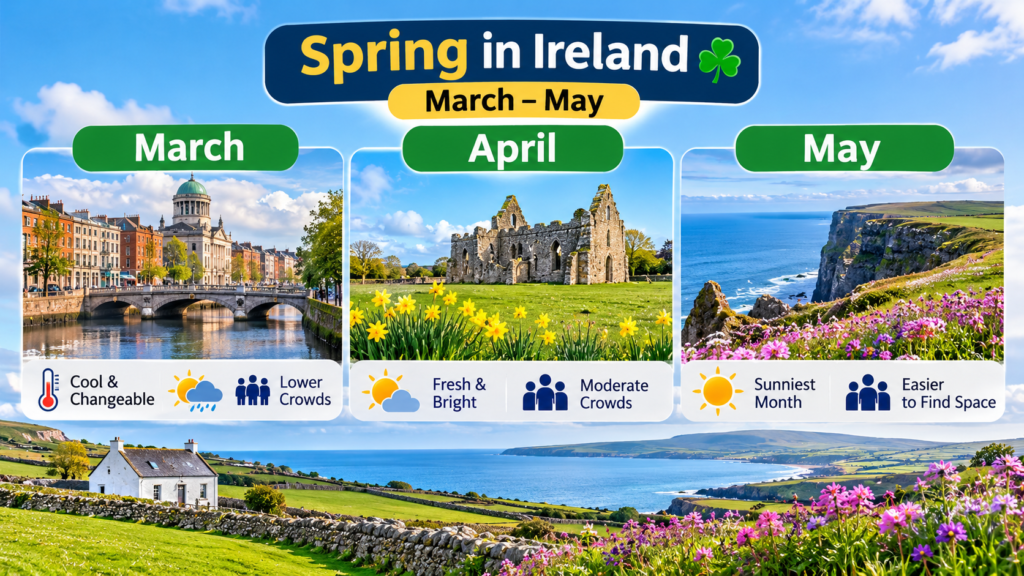
Spring brings lambs, wildflowers and some of the sunniest, driest weather of the year, along with sharp showers and cold mornings. Daylight stretches fast, from about 12 hours at the March equinox to over 16 hours by the end of May.
Ireland in March
March is cool and changeable, with lower prices everywhere except Dublin in St Patrick’s week. CSO figures show 441,200 overseas visitors in March 2025, well below summer levels. Book Dublin early for the festival, and pack warm layers for exposed coastal spots. Some rural attractions open only at weekends or wait until Easter.
Ireland in April
April is fresh, bright and unpredictable, so expect sun, hail and a rainbow in one afternoon. Gardens bloom, days stretch past 14 hours and crowds stay modest outside the Easter break. Easter Sunday falls on 28 March in 2027, so check school holiday dates before you book. Pack a waterproof jacket and an extra jumper.
Ireland in May
May is one of the best months to visit. Met Éireann’s 1991 to 2020 averages make it the sunniest month, and daylight lasts almost 16 hours. Hawthorn blossom fills the hedgerows, the Wild Atlantic Way wakes up and Skellig Michael landings usually begin in May, weather permitting. CSO figures show 560,500 overseas visitors in May 2025, well below August, so space is easier to find. The May bank holiday weekend runs from Saturday 1 to Monday 3 May in 2027.
Summer in Ireland
Summer delivers the longest days, the warmest temperatures and the fullest events calendar. It also delivers the biggest crowds, so your timing within the season matters. Met Éireann’s climate statement for summer 2026 provisionally rates it the hottest since records began in 1900, and a drier than average one. One hot summer guarantees nothing, so pack for rain anyway.
Ireland in June
June gives you the longest days of the year, with about 17 hours of daylight in Dublin and a sky that glows until close to 10pm. CSO figures show 654,500 overseas visitors in June 2025, still well below August. Seabirds crowd the western cliffs, and winds usually ease for island boat trips. The June bank holiday falls on Monday 7 June in 2027, so book that weekend early.
Ireland in July
July is warm by Irish standards, with long evenings and a full festival calendar. CSO figures show 646,400 overseas visitors in July 2025, and Irish families holiday at home too once schools break up for summer. Rooms in popular places such as Killarney, Galway and Dingle fill early, so book months ahead. Showers still arrive, so keep a rain jacket in your bag.
Ireland in August
August is the busiest month for overseas visitors, with 772,800 arrivals in 2025 according to the CSO. Days still run past 14 hours, the sea reaches its warmest and the festival calendar stays packed. Accommodation costs climb, so book early or choose bases away from the biggest hotspots. The August bank holiday falls on Monday 2 August in 2027.
Autumn in Ireland
Autumn brings golden light, harvest food and quieter sights, but days shorten fast and rain increases. Autumn 2025 ranked as the fourth wettest in 85 years of Met Éireann records, so plan indoor options for every day.
Ireland in September
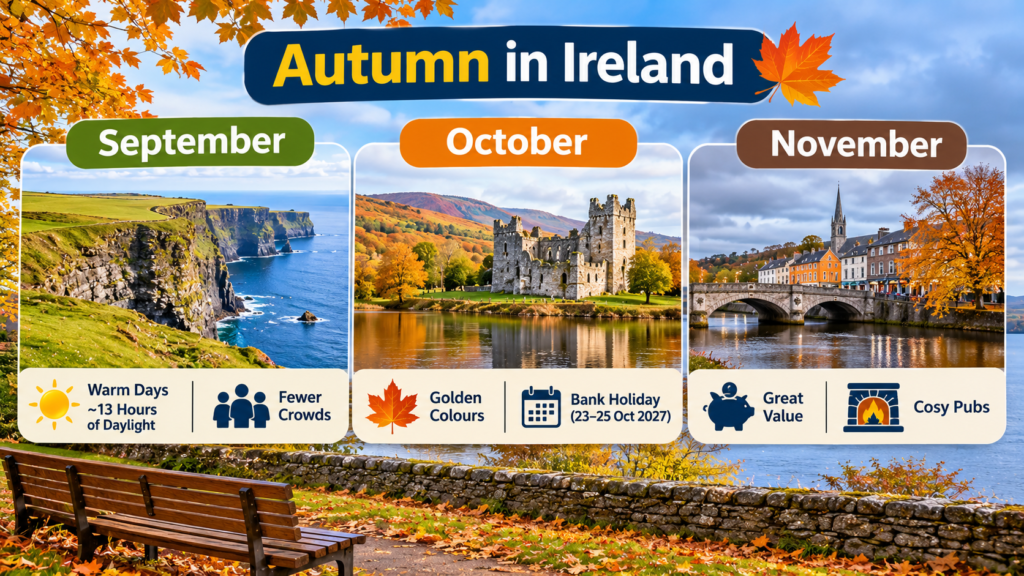
September is the smart pick for travellers who want warmth without the August rush. CSO figures show 604,500 overseas visitors in September 2025, about 22 percent fewer than in August. Days still last around 13 hours in the middle of the month. Weather can turn stormy late in the month, and storms can close Skellig Michael to visitors early.
Ireland in October
October trades warmth for atmosphere. Days shrink to around 11 hours in early October, rain turns more frequent and the clocks go back on the last Sunday of the month. In return, the light turns soft and golden and the crowds thin. Halloween has its roots in the Irish festival of Samhain, and the October bank holiday weekend runs from Saturday 23 to Monday 25 October in 2027.
Ireland in November
November is dark, damp and good value. The sun sets before 5pm from the start of the month, many rural attractions cut their hours or close for winter, and island ferries run less often. In return you get cheaper rooms, empty roads and pubs with open fires and live music. Stick to cities and indoor attractions, and carry a waterproof jacket every day.
Winter in Ireland
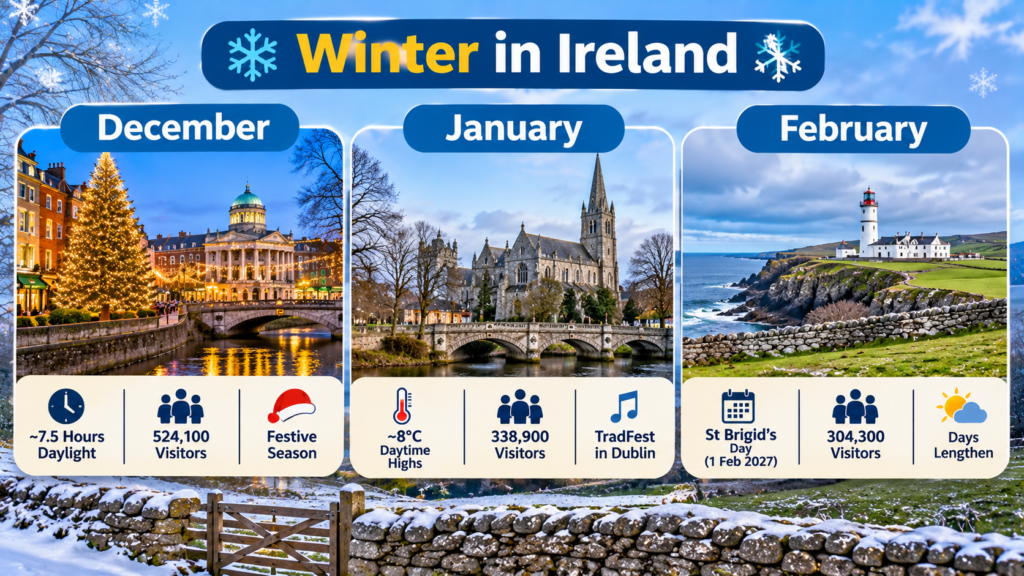
Winter is the quiet season, with short days, long nights and the lowest prices of the year, outside Christmas. Storms arrive from the Atlantic, so check Met Éireann warnings before any long drive or coastal walk.
Ireland in December
December mixes festive lights with some of the shortest days of the year, around 7 and a half hours in Dublin at the solstice. CSO figures show 524,100 overseas visitors in December 2025, and 47.1 percent of them list visiting family and friends as their main reason, so tourist sights stay quieter than that total suggests. Most attractions close on Christmas Day.
Ireland in January
January is cold, quiet and good value, with about 8 hours of daylight and daytime highs near 8°C. CSO figures show 338,900 overseas visitors in January 2025, far below summer. Temple Bar TradFest usually fills Dublin pubs with traditional music late in the month. Pack thermals, a hat and a proper waterproof, and keep driving days short.
Ireland in February
February is among the quietest months, with CSO figures showing 304,300 overseas visitors in February 2025. St Brigid’s Day gives you a public holiday on Monday 1 February in 2027. Days lengthen fast, to more than 10 hours by the end of the month, and city breaks suit visitors who like pubs and museums. Expect cold rain and wind, and check opening days for rural sights.
Best Time for Your Plans
Your plans matter as much as the calendar. These timing rules cover the trips visitors ask about most.
Dublin City Break
Dublin works in every month because its biggest attractions sit indoors, from the Guinness Storehouse to the National Museum. April, May and September give you mild weather and manageable queues. Avoid festival week in March unless you want the parade, and expect high rates on summer and bank holiday weekends. In winter, live music pubs and the Christmas lights make a short break worthwhile.
Wild Atlantic Way
The Wild Atlantic Way, a coastal route of about 2,500 km from Donegal to Cork, suits May to September best. Long daylight lets you take your time, winds usually ease and island ferries run more reliably. Outside those months, gales and short days limit what you see, and some seasonal cafes and tours close. Always add a spare day for weather, because fog and rain can hide a headland you drive hours to reach.
Cliffs of Moher
Visit the Cliffs of Moher in May, June or September for the best mix of light and manageable crowds, and arrive early or late in the day. Fog and rain can hide the view in any month, so stay flexible about the hour you go. Winter brings strong wind along the exposed cliff path, so dress warmly and follow the safety signs and barriers.
Skellig Michael
Skellig Michael works best from May to July. The OPW runs a summer landing season, and boats sail only when weather and sea conditions allow. Access runs through permitted boat operators, who charge separately, while the island itself costs nothing. Weather limits the season: the OPW reports only 61 landing days in 2025 after a late start and poor weather, and in 2026 landings end early on 21 September. Book flexible dates, and keep a spare day in case the boats stay in port.
Northern Ireland
Northern Ireland suits May, June and September, when the Giant’s Causeway and the Antrim coast offer good light and lighter crowds than July and August. Belfast works all year, with Titanic Belfast and St George’s Market for wet days. Remember that Northern Ireland uses pounds sterling, not euro, and its bank holidays differ from the Republic’s.
Walking and Hiking
April to September suits walkers best, with May and June offering the driest spells and the longest light. Mountain weather turns fast, so carry a map, a waterproof and warm layers, and check the forecast before you start. Coastal trails get slippery after rain, so wear shoes with proper grip.
St Patrick’s Festival
Come in March if you want the parade and the party, and plan early. The festival runs from Saturday 13 to Wednesday 17 March in 2027, and the parade starts at noon on Wednesday 17 March from Parnell Square. Organisers estimate about 500,000 people line the route. Book rooms and flights well ahead, or visit the week before for the same city at a calmer pace.
Packing for Irish Weather
Pack for four seasons in any month. Bring a waterproof jacket with a hood, layers you add and remove, and shoes that cope with wet grass. Umbrellas struggle in Atlantic wind, so a good hood does more. Download the Met Éireann app, read warnings each morning and plan one indoor option per day, such as a museum, a distillery or a pub session.
Give driving days extra time, because narrow rural roads move slower than the map suggests.
Final Words
The best time to visit Ireland depends on what you value most. Choose May or June for sunshine and long light, September for warmth with fewer people, and winter for low prices and cosy pubs.
Whatever month you pick, expect rain, pack a waterproof and keep one flexible day. Pick your dates now, then book your rooms and any Skellig Michael or Dublin tickets before they sell out.
FAQs
What is the best month to visit Ireland?
June is the best month for most visitors, with about 17 hours of daylight and a fair chance of dry spells. May suits you if you want the sunniest conditions and smaller crowds, and September keeps the warmth after the school holidays end. Book early for all three.
What is the cheapest month to visit Ireland?
January and February are usually the cheapest months, apart from the New Year period, because demand falls after Christmas. November also offers good value. Prices vary by year and route, so compare flights and rooms for your dates before you commit.
Which month is the driest in Ireland?
April, May and June are usually the driest months, with May the sunniest. Rain still falls in every month, and the west gets more rain than the southeast. Treat the averages as odds, not promises, and pack a waterproof whatever the forecast.
Is July a good month to visit Ireland?
July is a good month if you want warm weather, long evenings and a full festival calendar. It is also a busy month, because Irish families holiday at home once schools close, so book accommodation months ahead and keep a rain jacket handy.
Is Ireland worth visiting in winter?
Yes, if you enjoy cities, pubs, museums and quiet roads more than long days. Winter brings the lowest prices, but daylight drops to about 7 and a half hours in Dublin, storms arrive often and some rural attractions close. Stay flexible and check Met Éireann warnings daily.
When is Ireland least crowded?
January and February are among the quietest months, with February drawing just 304,300 overseas visitors in 2025 according to the CSO. For better weather with fewer people, choose May or late September. Avoid August and bank holiday weekends if you dislike crowds.
How long are summer days in Ireland?
Summer days last up to 17 hours in Dublin around 21 June, with sunrise near 5am and sunset close to 10pm. By late August the day shortens to about 14 hours. Western counties get later sunsets than the east.