
The Morrigan in Celtic Myth | Triple Goddess or Great Queen?
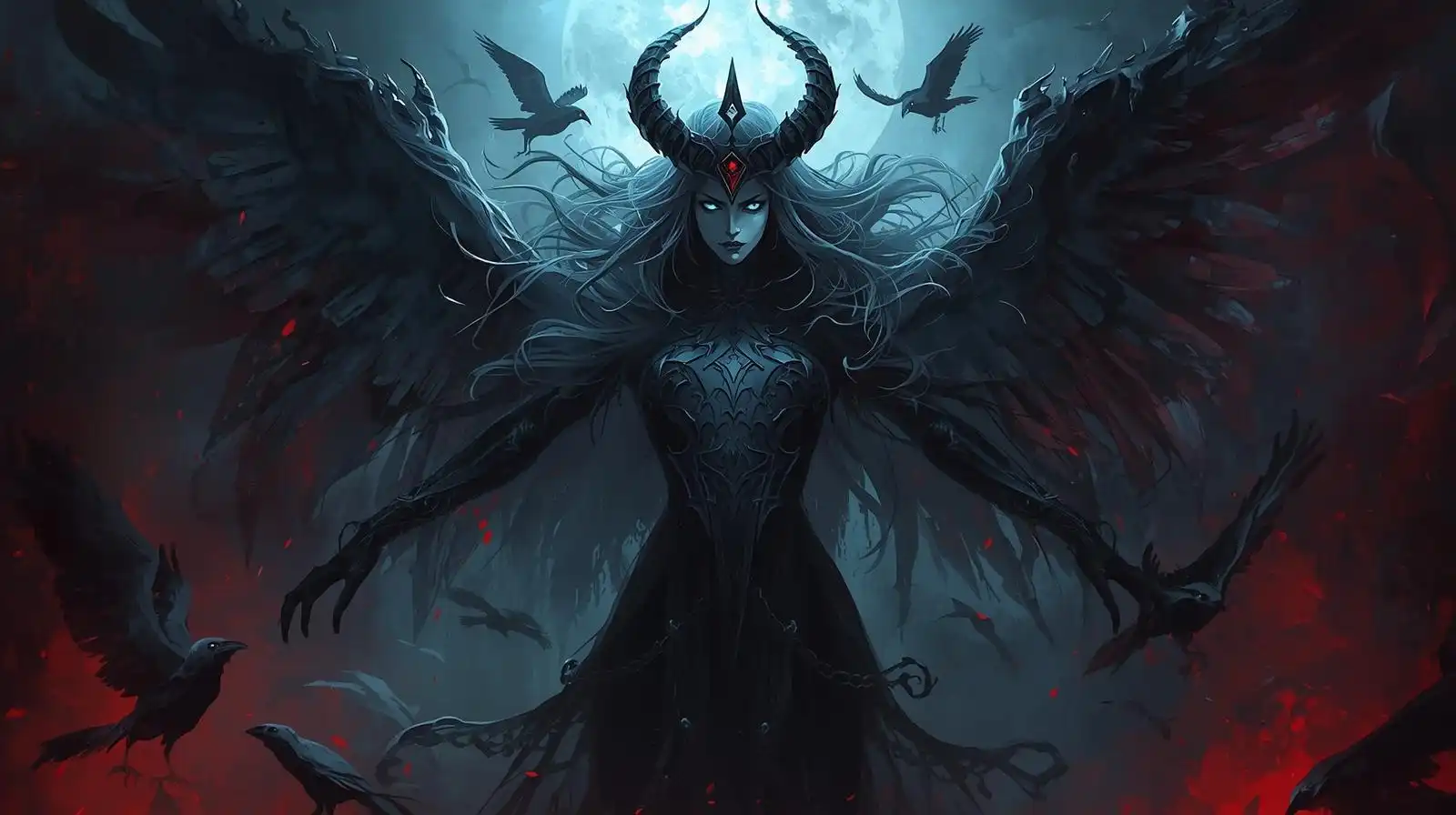
To understand the Morrigan’s origins, it is necessary to first examine the linguistics of her name. In Old Irish, the name appears as Mor-Ríoghain. Its etymology is also a subject of debate among scholars, with two hauntingly beautiful translations, namely “Great Queen” (mor, meaning great) or, as a phantom queen (mar, meaning nightmare or a supernatural creature).
Although she can be discussed within the broader category of Celtic gods. It is essential to explain her place within Irish mythology. She is not a stereotypical nature goddess. She is a royal force firmly embedded in the soil of Ireland and in the Tuatha Dé Danann tradition. She is a precursor of transformations in power which is evident in her being at the entrance to both life and death, and her Mor-rioghan translation would imply a figure who is subject to respect and an admirable level of fear.
Identity and Dual Nature: Single Goddess or Triple Aspect?
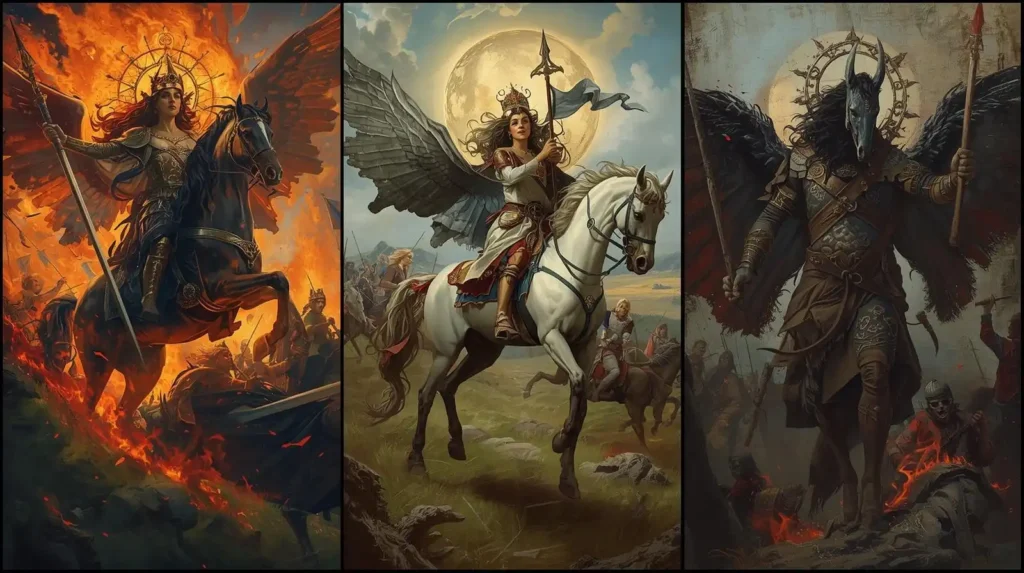
One of the key questions about the Morrigan’s identity is whether she is a single goddess or a group. Early tradition, such as the Lebor Gabála Érenn, presents her in a fluid and sometimes inconsistent manner. She is also quite often referred to as a triple goddess, a trinity of sisters representing various aspects of war and the oracle.
Although the names of this trinity vary across different manuscripts, the names of Badb, Macha, and Nemain (or anand) are the most widespread.
- Badb: This is usually used in reference to the madness of the battlefield.
- Macha: Associated with the land, sovereignty, and the horses of Ulster.
- Nemain/Anand: The symbol of the frightening horror of war.
This threefold concept of the Morrigan reflects the ancient Irish understanding of deity, not as a fixed personality, but as one that can be changed to fit the demand of fate, to appear in a variety of forms.
Domains and Symbolism: The Crow and the Battlefield
The Morrigan symbolism is full of the visceral realities of the Iron Age. Her main realms are war, fate, sovereignty and prophecy. She is not just a mere goddess of the idea of victory as we know it; she is the psychological and physical reality of the battleground.
The crow or raven is her most recognisable icon. In Irish tradition, when people saw a crow hovering over a battlefield, it was regarded as the morrigan herself awaiting the departure of the spirits of the dead. Beyond her bird form, she is a mistress of disguise, having an ability to transform into an ancient hag, a beautiful young girl or even a heifer.
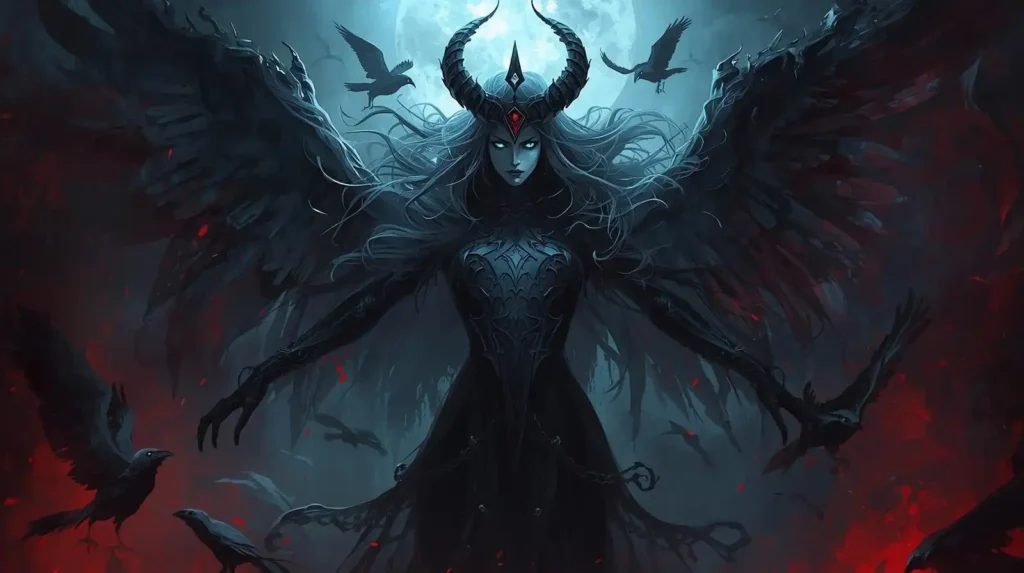
The one most frightening of her symbols is the Washer at the Ford. She frequently is shown polishing the blood-streaked armor of the men who will die in the impending battle. This is a foreboding ritual of battlefield washing, and the borderline between the living and the dead.
Key Myths and Stories
Morrigan myths carry significant weight within the great cycles of Irish literature. The moral and physical universe of the stories is characterised by her dealing with heroes and gods.
Morrigan in the Ulster Cycle (Cú Chulainn)
The Morrigan and the hero Cú Chulainn is one of the most well known antagonistic relationships in the mythology. She initially met him as a gorgeous woman presenting her love and support in war. When the hero rejected her, she vowed to hinder him at his moment of greatest danger.
As promised, she attacked him, in the shapes of an eel, a wolf, and a red heifer, in his fight at the ford.
Battles of Mag Tuired
Morrigan is very central in the triumph of the Tuatha Dé Danann over Fomorians in the battle of Mag Tuired (The Battle of Maige Tuired). She encounters the god, Dagda, before the battle, at the river Unshin.
They unite on Samhain Eve to ensure the fertility of the land and victory in the coming war. She subsequently drains the courage out of the Fomorian king using her magic which goes to show that her power is both intellectual and magical as well as physical.
Washer at the Ford
The Morrigan is presented in different tales as an ominous symbol in the form of the Washer at the Ford. She is a connector between the physical world and the Otherworld by washing the equipment of warriors. The role adds an element of fate to her, which makes her not only a contributor of the result but also a spectator of the destined.
Interpretations Through History
The historical interpretation of the Morrigan has changed greatly since the medieval times up to the contemporary times. The majority of what we know is what was documented by Christian scribes centuries after the oral traditions had started.
These monks often sought to demythologise the gods, to transform them into kings or queens in history who were subject to magic as opposed to deities.
In these Christian Irish manuscripts, the Morrigan was sometimes equated with demons or malevolent spirits. This distorted vision tried to weaken her divinity, but her strength was so inherent in the tales that she was one of the main, though darker, elements of the Irish mind.
Modern and Cultural Impact: The Goddess Today
The relevance of Morrigan has gone up in the 21st century. She has gone beyond the dusty manuscripts to be a representative of female strength, independence and reclaiming of the darker feminine aspects.
But one of the myths in modern Morrigan paganism is the following one. Many modern interpretations present her as a so called maiden, mother, crone figure, a Neopagan idea of her that does not necessarily correspond to the original Old Irish texts.
She was far more complex and less stereotyped in her original lore than it is implied in the contemporary Wiccan views. Her influence on culture continues to this day in literature, video games, and feminist art. There, she is regarded as a protector of individual boundaries and a ruthless defender of the land.
Conclusion: The Legacy of the Phantom Queen
From the story of the Morrigan, we see a force that is neither wholly good nor evil, but is a part and parcel of nature. She is the mistress of the battlefield. She is the queen of the threshold and the weaver of fate. Her narrative makes us remember that sovereignty is a product of struggle and that life is one side of the coin and death the other.