
Newgrange: The Complete Guide to Ireland’s Ancient Tomb
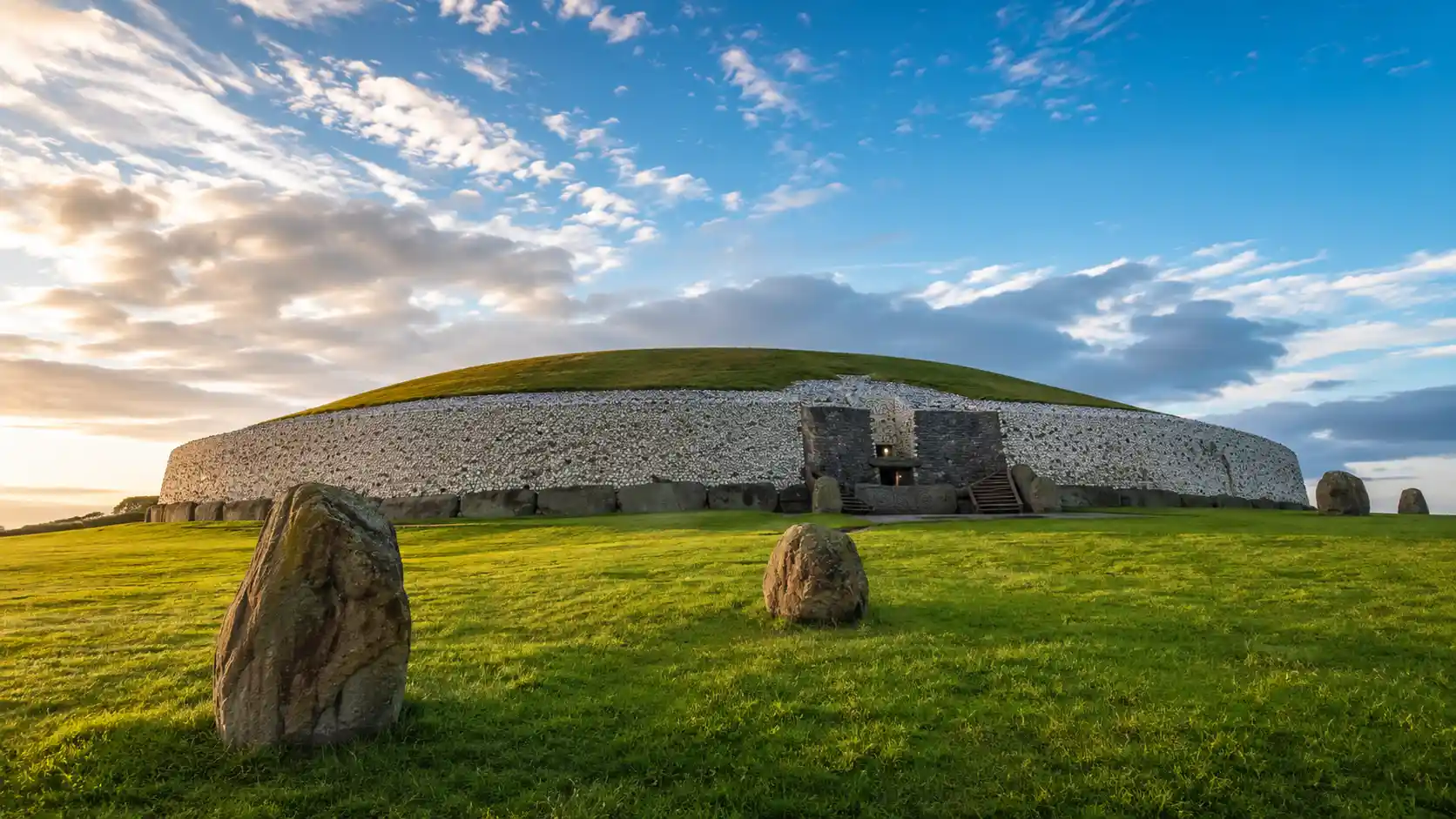
Newgrange sits on a low ridge above the River Boyne in County Meath, and Neolithic farmers finished building it around 3200 BC. That makes the tomb older than Stonehenge and older than the pyramids of Giza. Anyone researching Irish heritage sites eventually lands here, because it remains the most recognisable prehistoric monument in Ireland.
This guide covers what Newgrange actually is, how the winter solstice alignment works, and what a real visit involves today. It also answers the practical questions that most articles skip, including tickets, timing and getting there.
What Is Newgrange?
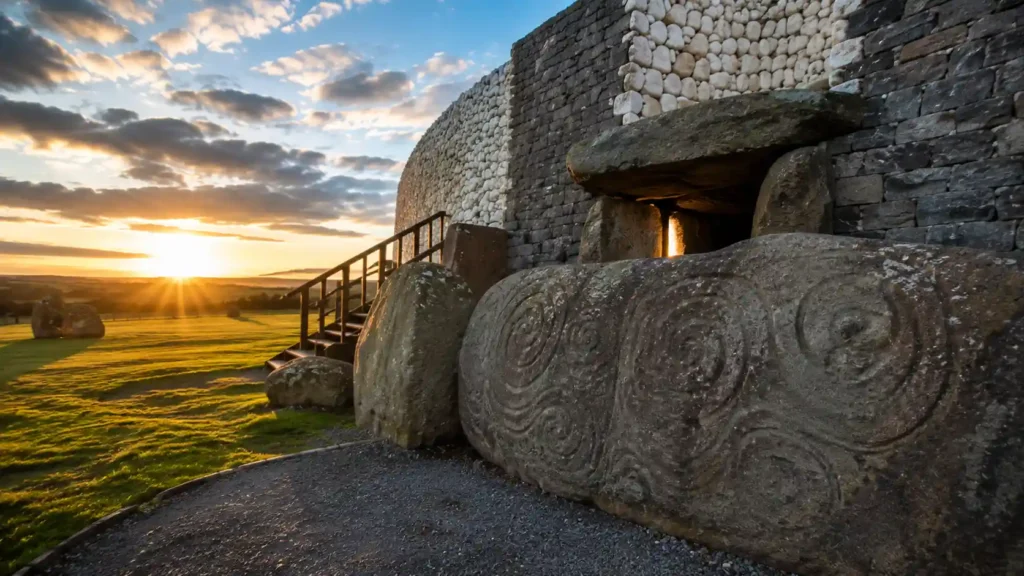
Neolithic farming communities built Newgrange as a passage tomb roughly 5,200 years ago. The mound spans 85 metres across and rises 12 metres at its highest point, and it covers a stone lined passage that leads to a central chamber. Builders surrounded the structure with 97 kerbstones, and the largest of these, the entrance stone, carries a striking triple spiral design.
Archaeologists classify the site as part of a wider passage tomb tradition that spans Neolithic Europe. Ireland’s example stands out for its scale, its megalithic art and its solar alignment, qualities that few comparable monuments share.
The Meaning Behind the Name
The Irish name for the site is Sí an Bhrú. “Sí” refers to an otherworld dwelling that Irish folklore often links to burial mounds, while “Bhrú” translates loosely as a hollow or womb. The English name Newgrange comes from a much later medieval farm, or grange, that monks near Drogheda once managed on the land.
The History of Newgrange
Its story spans more than five thousand years, from a remarkable feat of Neolithic engineering to a chance rediscovery centuries later.
Who Built Newgrange?
Neolithic farmers built Newgrange without metal tools, wheels or a written language, yet they still transported stones from up to 30 miles away. Workers hauled greywacke slabs from the coast near Clogherhead and carried white quartz cobbles down from the Wicklow Mountains. Engineers designed the corbelled roof so precisely that it has kept out every drop of rain for over five thousand years.
How Long Did It Take to Build?
Researchers estimate that the project took several decades to finish, given the sheer volume of stone involved. Coordinating that labour without wheeled transport or draft animals demanded careful planning and a large, organised workforce. Some archaeologists believe the community treated the construction itself as a ceremonial act rather than a purely practical one.
Rediscovery in 1699
Charles Campbell, a local farmer, rediscovered the entrance to Newgrange in 1699 while his workers quarried stone from the mound. Edward Lhwyd, a Welsh antiquarian, happened to be staying nearby, and he explored the passage soon after the discovery. Inside, he documented animal bones, fragments of glass and human remains, findings that sparked decades of competing theories about who had built the site.
Newgrange and Brú na Bóinne
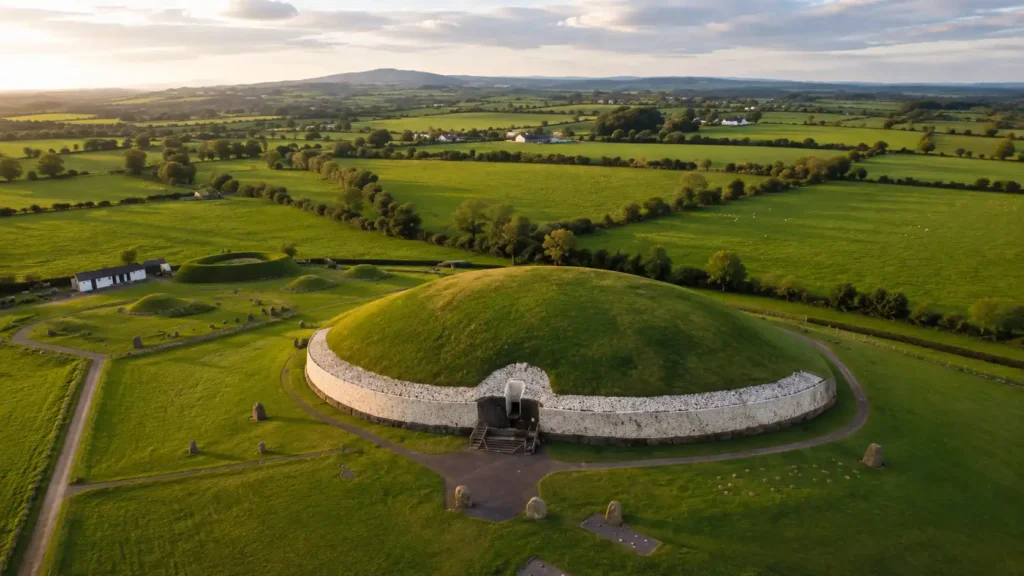
Newgrange forms part of Brú na Bóinne, a UNESCO World Heritage Site that UNESCO inscribed in 1993. The wider landscape holds two other major passage tombs, Knowth and Dowth, along with 36 smaller satellite tombs scattered across a bend in the River Boyne. Together these sites hold the largest concentration of megalithic art found anywhere in Western Europe.
Knowth and Dowth
Knowth sits close to Newgrange and displays over 300 decorated stones, a collection that gives it more visible megalithic art than the more famous tomb next door, even though visitors cannot enter its chamber. Dowth remains the least visited of the three, but it still hosts its own solstice alignment on the shortest day of the year. Most guided tours combine the two main tombs, while Dowth stays outside the standard ticket.
Inside the Newgrange Chamber
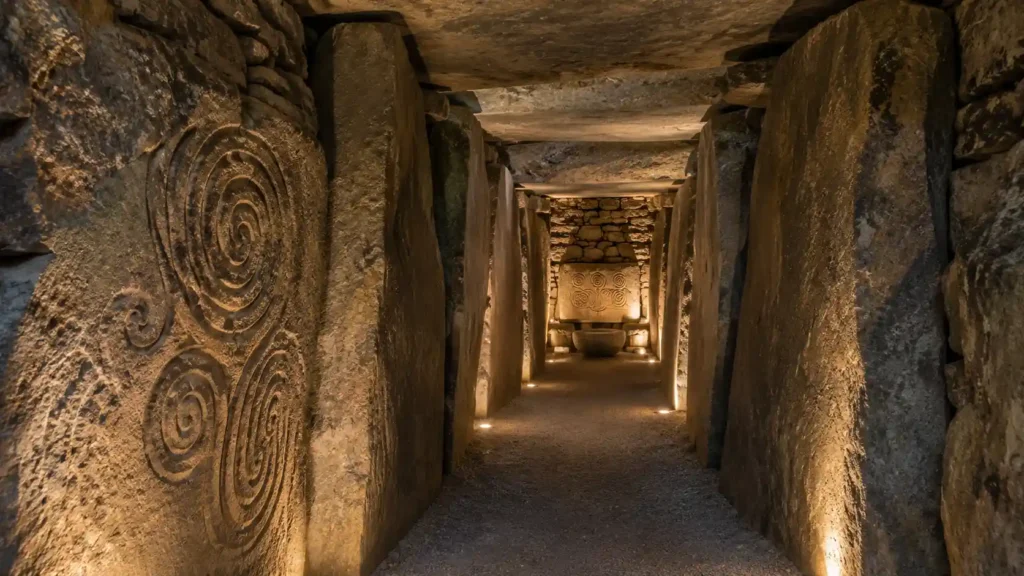
A passage roughly 19 metres long leads visitors from the entrance into the central chamber. The chamber then branches into three smaller recesses, and large stone basins inside once held cremated human remains alongside grave goods. Builders topped the chamber with a corbelled roof that still supports an estimated 200,000 tonnes of cairn material above it.
Megalithic Art
Carvers decorated many of the site’s stones with spirals, lozenges and concentric circles, and the entrance stone remains the most photographed example. Inside the passage, a second triple spiral carries the name triskele. Archaeologists still debate the exact meaning of these motifs, though most agree they held ceremonial or astronomical significance.
The Winter Solstice at Newgrange
Every year between 19 and 23 December, a narrow beam of sunlight enters Newgrange through an opening above the entrance. Builders designed this opening, which people now call the roof box, purely to catch the solstice sunrise. Neolithic engineers achieved this alignment more than five thousand years ago using nothing beyond careful observation of the sun.
How the Alignment Works
The roof box sits precisely above the main entrance, and its angle channels sunrise light along the passage only during the days surrounding the winter solstice. As the sun climbs, the beam widens and lights the full chamber before it retreats the way it came. Weather ultimately decides whether visitors see the full effect, since cloud cover can block the alignment even on the correct morning.
The Solstice Lottery
The Office of Public Works runs an annual lottery each September to choose who stands inside the chamber at dawn. Roughly 16,000 to 30,000 people apply most years, yet only 38 places exist across the five solstice mornings. Winners may bring one guest, and anyone who misses out can still gather outside the monument to watch the sunrise.
How to Visit Newgrange
Every visit follows the same basic pattern, though the exact details shift with the season.
Tickets and Tour Options
Visitors cannot walk up to the monument or drive directly to it, since every visit begins at the Brú na Bóinne Visitor Centre near Donore. The combined Brú na Bóinne tour includes both Knowth and the tomb itself, runs for about three hours, and costs 18 euro for an adult in 2026. A shorter Newgrange only tour covers just the chamber and exhibition, and it becomes the sole option once Knowth closes for winter.
Getting There
The Brú na Bóinne Visitor Centre sits roughly 50 kilometres north of Dublin, and most visitors reach it by car in under an hour. Staff then transport everyone across the River Boyne by shuttle bus, since private vehicles cannot access either monument directly. Travellers without a car can join a day tour departing from Dublin city centre instead.
Best Time to Visit
Summer slots at Newgrange sell out within hours of release, so booking 30 days ahead gives the best chance of a place. Winter months bring smaller crowds and a shorter tour that skips Knowth, which stays closed during that period. Anyone hoping to witness the solstice illumination itself must enter the September lottery well before December arrives.
Accessibility and Practical Tips
The passage into the chamber is narrow, low and roughly nineteen metres long, so anyone with mobility restrictions or a fear of enclosed spaces should contact the visitor centre before booking. Staff do not permit photography inside the passage or chamber, though photography around the exterior mound is welcome. Since most of the visit happens outdoors on an exposed site, sturdy footwear and a waterproof jacket make the experience far more comfortable.
Is Newgrange Worth Visiting?
Newgrange earns its reputation as one of Europe’s most important prehistoric sites, and the chamber experience alone justifies the trip for most visitors. Combining it with Knowth adds real depth, since the two monuments show different sides of the same Neolithic culture. Anyone building an Ireland itinerary around ancient history should treat this ancient monument as an essential stop.