Irish Harp History | How the Harp became the symbol of Ireland?
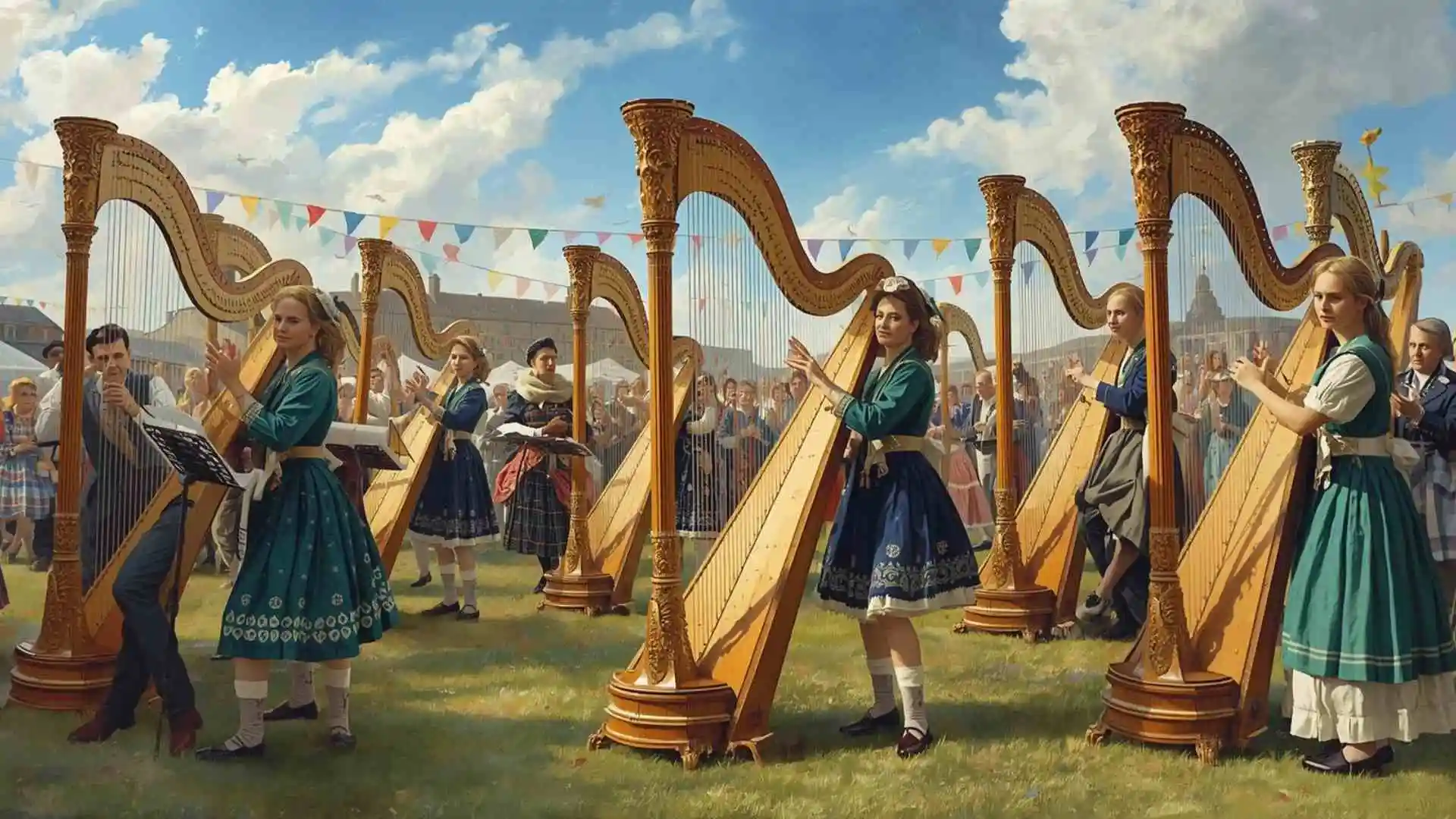
You might have had it anywhere – on plums, on official documents, and on your favourite stout. The pageant of the Irish harp is a beautiful instrument. We are not going to talk merely of a piece of wood and strings, we’ll talk about its history.
In this article, you’ll find about Irish harp history, why it was the last symbol of Ireland, and the wonderful legends that have surrounded it.
We’ll also discuss the literary actors that have perfected it, its place in modern culture and some tips on how you can start playing a note or who knows, you can even make a suggestion. So, let’s go.
Irish Harp History
We’ll begin with the very cool historical fact of this marvellous instrument. The old version of Irish harp (or clairseach in Gaelic) is more than one thousand years old. Also, it need not necessarily be the beautiful shape as we are accustomed to know it. It may come as a surprise to many. The early ones were far simpler, but the music was already magic.
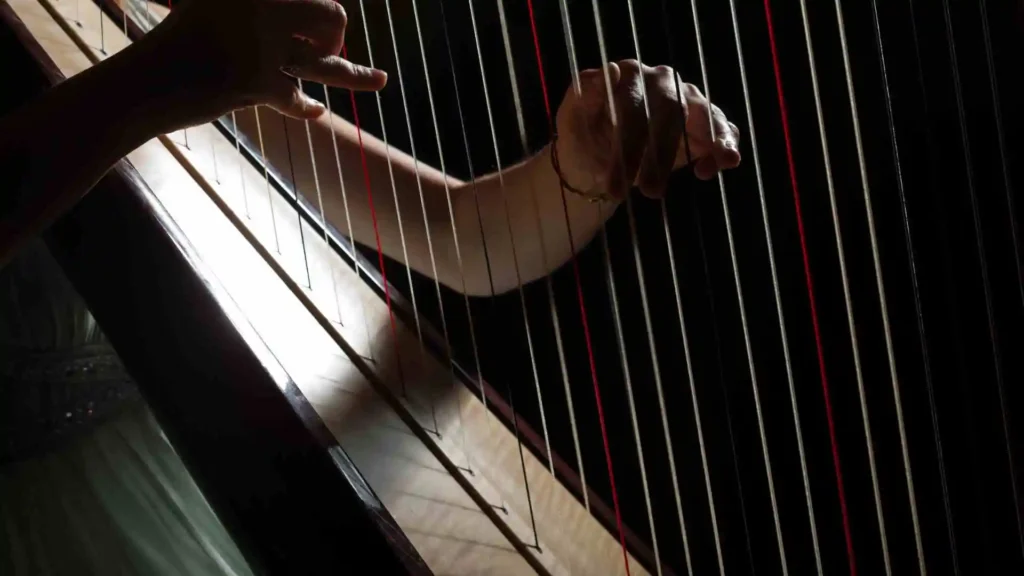
The history of the harp in Ireland began with the primitive celtic harps. They evolved from simple stringed instruments to the revered traditional Irish harp. Its development relates closely to the Irish chieftain courts and the professional harpers. The harpers preserved the nation’s oral history and music, laying the foundation of cultural heritage.
These early Celtic harps were the rockstars in the courts of chieftains and high kings of Ireland, like the legendary Brian Boru. Harper was not only a musician. They were well-respected members of society who frequently travelled with their lords, telling stories and playing music that was central to social life. This close link to the nobility is what caused the instrument’s cultural significance to spread so quickly. And they were the keepers of the past.
The distinct triangular shape and soundbox of the traditional Irish harp are generally theorised to have been influenced by many elements of Europe. But the Irish made it their own, fitting metal strings and creating unique playing styles. This tradition illustrates why this instrument is one of the oldest Celtic symbols that we have today.
To see how this instrument compares to its variants globally, check this great overview of the variations and history worldwide. It is an unbroken tradition, and it is rather incredible to think of it so.
Why Is the Harp a Symbol of Ireland?
Ireland was the sole state to use a musical instrument as its national emblem (musical instrument), which is non-violent, unlike other nations whose national symbols are animals or swords.
Harp was symbolically printed on Irish coins as early as the 13th century. It was also on the new coinage of the Kingdom of Ireland in 1531 by Henry VIII. Nevertheless, its symbolic power exploded during the 17th and 18th centuries as it was employed as a quiet but powerful symbol of Irish nationalism against the foreign foreign. People wore Irish badges as a symbol of cultural identity, when it was dangerous to speak out.
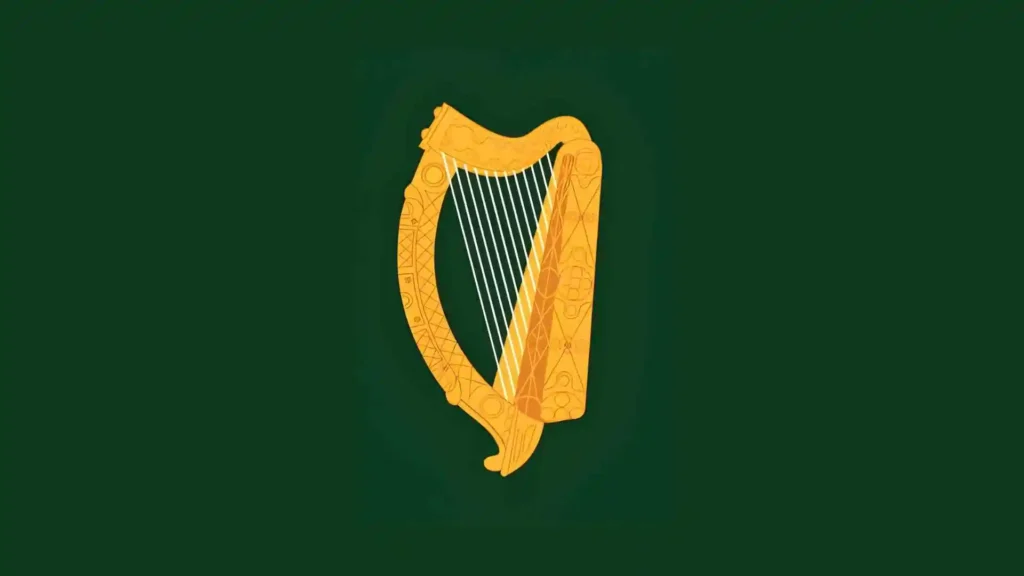
The Ireland symbol is everywhere today. It is on the official State Seal, on all the coins of the Euro that are minted in the country, and on the Presidential Standard. And make it today, now, The Guinness harp that we know.
Fun fact: In the year 1862, the instrument was used by Guinness as the corporate logo. The state of Ireland had to differentiate its symbol. When you look closely, you will find the symbol of the governmental harp is always on the left, but that of Guinness is on the right.
And one small, yet, indeed important circumstance about it is that it shows how far this instrument is ingrained in the consciousness of the nation.
Irish Harp in Mythology and Culture
The Irish harp as a symbol of Irish identity can be traced back as far as the 16th century when the harp was introduced into Irish territory. The Irish harp is fully surrounded by Irish myths and folklore. It is not everything that is made by wood and strings, but it is a living part of the culture.
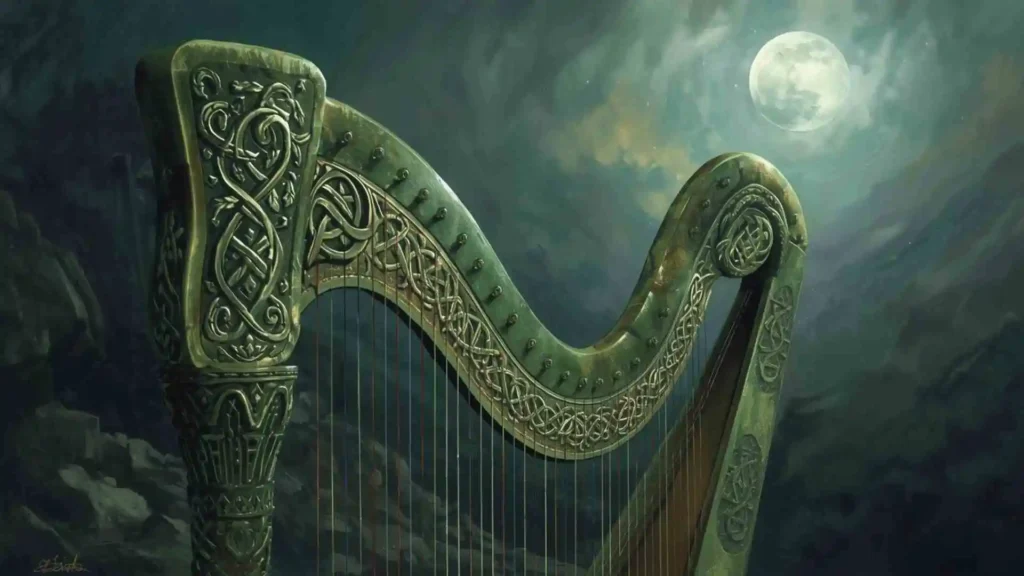
Dagda is the most established myth of the harp that is connected with a god of music and poetry. His harp was called Uaithne and was considered to be magic. It was equipped with three great strains of music, namely Goltrai (weeping strain), Geantrai (joyful strain), and Suantrai (sleeping strain). And won’t that be so cool at a party?
The other instrument that might have been the most significant tool in the world is the Brian Boru harp. It is a mediaeval instrument housed in Trinity College in Dublin, along with the gods.
It might not be the actual Irish harp of the High King Brian Boru (died in 1014). However, it is among the oldest extant instruments, hence the reason why it is a religious relic. The connection with the great king merely fuses the instrument in the national history.
These tales are very well connected with other folklore tales that have been passed through the generations in Ireland. It is the soul of the nation–the actual document of the power of music of centuries.
These tales connect deeply with other Irish folklore stories passed down through generations. The instrument represents the soul of the country, a true testament to the power of music over centuries.
Famous Irish Harpers and Their Legacy
No instrument is complete without its masters, and the history of the Celtic harps is full of luminous performers. These fellows were not ordinary musicians, but were superstars of their era and continued to play the traditional melodies in turbulent times.
The name that you simply must know is that of Turlough O’Carolan (1670-1738). He has been dubbed the national composer of Ireland and the final of the great itinerant harpers. Despite being blind through his life, his music, much of which resembles more Baroque music than a traditional jig, is played by virtually every Irish musician today. He is the Bob Dylan of the old Irish harp.
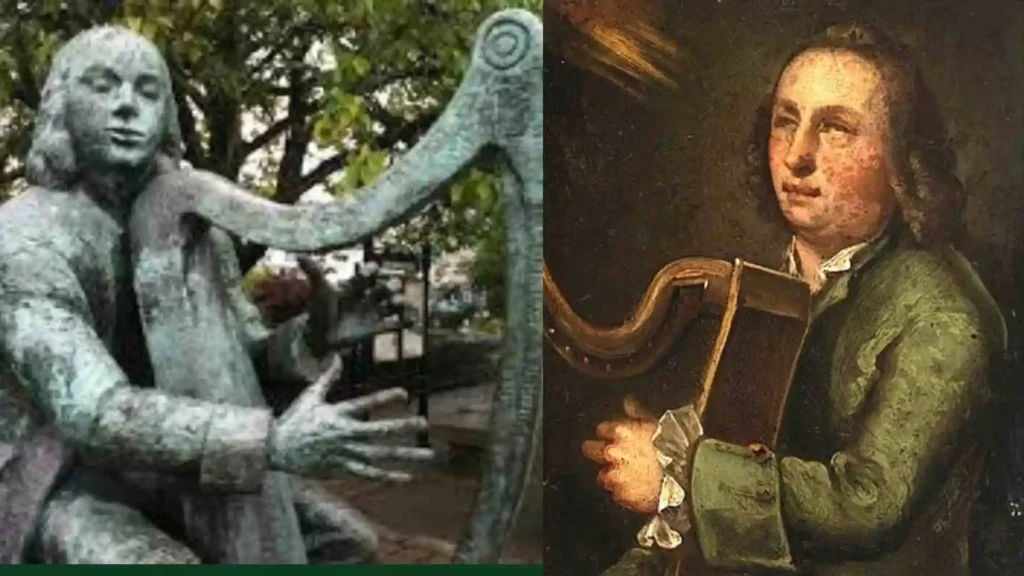
Another marvellous character is Donnchadh O Hamsaigh (Denis Hempson, 1695-1807), a harper who outlived his 112th year of existence. One of the few, he himself carried on with the old practice of playing with long fingernails.
Moving to the modern age, we have Derek Bell (1932-2002), a member of one of the legendary bands, The Chieftains. He assisted in making the sound of the Celtic harps known to a huge global audience, with its versatility also including flutes and fiddles. These geniuses ensured that the instrument’s voice did not die out.
Modern Use of the Irish Harp
We all know the Guinness harp on a fat bottle, but we question, what became of the musical life of the instrument in modern days? Is it fair in traditional pubs? Absolutely not, Irish harp is having a renaissance, it can be found at any place in the most unbelievable places.
You can hear it feature prominently as a part of modern Irish music, providing it a basis, ethereal in both groups and in individual performances. Modern harp-players are continuously enhancing the capabilities of this instrument, and folk, ambient electronic musicians are not an exception.
The harp fusion movement includes the fusion of the instrument with jazz, classical, and world music. It is no longer confined to the olden days. It is an instrument that can be employed in all seasons.
Have you observed the harp in modern music performances? It’s a captivating sight. Catrin Finch or Siobhan Armstrong are only some examples of how the world can prove that the sounds of the Celtic harps can be as topical and energetic as thousands of years ago. It is a beautiful tune that imparts sophistication and an Irish touch to any track.
Learning to Play the Irish Harp
Feeling inspired to pick up an instrument yourself? Irish harp is far too good to be learned. Instead of using a pedal harp, the lever harp (the most used in the playing of traditional Irish music) is a more portable instrument and tends to be easier to pick up. To start with, the following is a very short guiding tool:
- Choosing a Harp: Start small. There will be a lever harp desired of between 26 and 34 strings. This is also known as a harp that beginners use, and is a compromise on price and sound.
- Seek a Teacher: As good as online resources and books may be, a gifted teacher can assist you with the correction of techniques and mastering the specifics of ornamentation of phrasing the classic Irish music.
- Access Tutorials: Search for specific harp tutorials that focus on Irish traditional music. The treasure of lessons and demonstrations is YouTube.
- Little and Often: This is mostly due to consistency. Even fifteen minutes a day would be better than one or two-hour sessions a week.
You can invent your own beautiful tunes on the traditional Irish harp with a small time and just a bit of dedication.
Conclusion
Well, that was quite a journey. It is this pure, sonorous voice of this one instrument that we’ve travelled through the courts of the old kings to the world of music today. Irish harp history is not just the mere book history of a musical instrument but the living, breathing history of Ireland. It stood the test of time, becoming the harp symbol of strength, culture, and nationalism. No matter where you see it, on a Euro coin, in a bottle of stout, or as a melody, do not forget the incredible tale of the strings. It is a truly classic delicacy, for you to listen to.